
Key points for reverse engineering of processing machines
Processing machines are important equipment that support production sites for a long period of time. However, with machines that have been in operation for decades or old processing machines made overseas,
"The blueprints do not exist." "The manufacturer has already gone out of business." "Genuine parts are not available."
As a result, even a small malfunction can lead directly to a production stop, and it is not uncommon for this to develop into delivery delays or quality risks.
The solution to these problems is "reverse engineering." Particularly in the case of processing machines, the key is whether or not worn parts and mechanisms that directly affect production efficiency can be accurately reproduced.
In this article, we will explain in detail everything from the basics of reverse engineering of processing machines to the points you should keep in mind when making a request.
1. What is reverse engineering of processing machines?
Reverse engineering is a technique for analyzing existing parts and mechanisms from the "actual" object and restoring and reconstructing design data. In the case of processing machines, the main purpose is to reproduce parts that are no longer available due to wear, damage, or obsolete items.
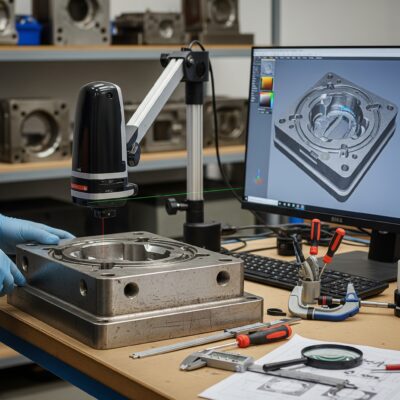
Specifically, the process begins with obtaining dimensional data for the actual part using a laser scanner, industrial CT scan, or 3D measuring machine. Even if there are worn areas, by restoring the CAD data while understanding the original design intent, it becomes possible to remanufacture parts that are as good as new.
For example, if an arm part of a transport device such as a gantry loader is damaged and the manufacturer no longer supplies it, it would normally be necessary to consider replacing the entire line. However, by utilizing reverse engineering, it is possible to analyze the dimensions and material properties of the arm from the actual part and restore the original part. This allows production to continue while avoiding investment in new equipment.
▼Check the basic information of reverse engineering▼
2. Key points for reverse engineering of processing machines
There are several points to keep in mind when requesting reverse engineering, and the main points you need to keep in mind are as follows:
Point 1: Clarify the purpose of the request
The goal of reverse engineering is not just to copy the shape.
・Is the purpose just to reproduce the part? (e.g., it is okay if the part has the same shape as the original part)
・Do you want to make improvements (e.g., increase wear resistance, improve assembly precision)?
- Do you want to keep it as a digital asset? (e.g., want to save CAD data for future preventive maintenance or design improvements)
It is important to clearly communicate your objectives. If you request something without clearly defining your objectives, you run the risk of it being more precise and expensive than necessary, or not achieving the required specifications.
Point 2: Maintain a balance between cost, quality, and delivery time
When requesting reverse engineering, it is necessary to consider the balance between the cost, time, and quality that can be achieved.
【cost】
Since the cost varies greatly depending on the complexity of the part and the precision required, it is necessary to provide a photo and outline of the part before placing an order.
【quality】
Recent 3D scanning technology has an accuracy of several tens of microns, which is sufficient for reproducing parts for processing machines. However, if worn-out parts are simply digitized, the parts will be manufactured with the same dimensional errors.
Some companies are able to correct the provided scan data based on the design intent rather than using it as is, and create CAD data that is closer to the correct shape.
【Delivery date】
For small parts, it typically takes a few days to a week from scanning to modeling, while for large machined parts it typically takes 1 to 2 weeks. This is a significant reduction compared to the traditional method of "designing from scratch."
Point 3: Accurately communicate the information you need to provide when making a request
As mentioned in the points above, the following information must be shared when making a request:
・The actual part in question (condition of wear, presence or absence of damage)
- Usage conditions (environmental information such as load, friction, temperature, etc.)
- Required precision (micron level or millimeter level)
・Delivery format (CAD data, processed parts, mass production availability)
With all the above information in hand, manufacturers can select the optimal measurement and modeling methods, which ultimately leads to reduced costs and shorter delivery times.
If you have any questions or concerns, please contact the "Equipment and Automatic Machine Parts Reverse Engineering Center."
Reverse engineering of processing machines not only extends the life of old equipment, but also leads to cost reduction, shorter delivery times, quality improvement, and the accumulation of design assets.
When making a request, it is important to clarify your objectives, understand the balance between cost, quality, and delivery time, and then hire a reliable company.We have a wealth of experience, mainly in processing machines and molds, and we use the latest 3D scanning equipment and skilled modeling technology to propose optimal solutions that meet the challenges on site.
If you are looking to extend the life of your old processing machine or are having trouble finding parts, please feel free to contact us.
>>Click here for inquiries about reverse engineering of processing machines

Enhanced safety features through reverse engineering: Area sensors
Introduction Reverse engineering often involves requests to recreate parts from older machinery that are no longer supported. However, many older machines prioritize production capacity and do not meet modern safety standards, and the machines are problematic…
Enhanced safety features through reverse engineering – Double switch
Introduction Reverse engineering often involves requests to recreate parts from older machinery that are no longer supported. However, many older machines prioritize production capacity and do not meet modern safety standards, and the machines are problematic…

Reverse Engineering for Enhanced Safety – Safety Fences
Introduction Reverse engineering often involves requests to recreate parts from older machinery that are no longer supported. However, many older machines prioritize production capacity and do not meet modern safety standards, and the machines are problematic…

Reverse Engineering and Components ~Screw Shafts~
Introduction When older machinery is beyond repair, we receive inquiries about reverse engineering. While we receive inquiries about a wide variety of machines, there are certain parts that we are surprisingly often asked to work on. This column will discuss such parts…

Reverse Engineering: How to Avoid Failure? Part 2
Introduction: Reverse engineering is a technique that can repair parts of machines whose support has ended, but it cannot repair all products and parts, and there is a possibility of failure. This column will explain how to perform reverse engineering…

Difficult even with the physical object? Reverse Engineering of Gears
Introduction Gears are a common subject of reverse engineering requests due to their failure. While the basic mechanism of power transmission is the same, the shapes and combinations of gears vary greatly depending on their application. Even I, the author, discover something new every time I research gears…

Points to note when choosing grease
Introduction: Most machines with rotating parts, such as shafts, use bearings. Inside the bearings, grease is sealed to prevent wear and ensure smooth operation. Different types of grease are used depending on the application…

Reverse Engineering Techniques: Material Selection Based on Application (Part 3)
Introduction When using reverse engineering to repair old machines and restore parts, the material of the part can be a headache. If you make a new part using the same material as the damaged part, you can't easily distinguish it by measuring it with measuring tools or by looking at its color because the original part is still available...

What are the advantages of 3D printers that shine through reverse engineering?
Introduction 3D printers have become commonplace, not only in the manufacturing industry but also among many people who use them personally as a hobby. However, there are many advantages to effectively utilizing 3D printers in the field of reverse engineering. This time…

What are the essential points to check when reverse engineering!? <Part 3 - Components>
Introduction Reverse engineering, while a broad term, deals with a wide variety of machines and parts. Analyzing such diverse objects using reverse engineering is no easy task. In fact, when proceeding with reverse engineering…

Reverse Engineering Techniques: Material Selection Based on Application (Part 2)
Introduction When using reverse engineering to repair old machines and restore parts, the material of the part can be a headache. If you make a new part using the same material as the damaged part, you can't easily distinguish it by measuring it with measuring tools or by looking at its color because the original part is still available...
Reverse Engineering Techniques - Selecting Materials by Use, Part 1
Introduction When using reverse engineering to repair old machines and restore parts, the material of the part can be a headache. If you make a new part using the same material as the damaged part, you can't easily distinguish it by measuring it with measuring tools or by looking at its color because the original part is still available...
Reverse Engineering Techniques - Material and Substance Investigation Part 2
Introduction When using reverse engineering to repair old machines and restore parts, the material of the part can be a headache. If you make a new part using the same material as the damaged part, you can't easily distinguish it by measuring it with measuring tools or by looking at its color because the original part is still available...

Reverse engineering technology - material and substance investigation
Introduction When using reverse engineering to repair old machines and restore parts, the material of the part can be a headache. If you make a new part using the same material as the damaged part, you can't easily distinguish it by measuring it with measuring tools or by looking at its color because the original part is still available...
How to avoid failure in reverse engineering? Part 1
Introduction Reverse engineering is a technique that can restore parts of machines that are no longer supported, but it cannot restore all products or parts, and there is a possibility that it will fail. In this column, we will explain how to reverse engineer...