
Key points for reverse engineering blow molds
Blow molds are essential for the manufacture of beverage and food containers, but years of use can cause wear and tear on parts, which can affect quality and productivity.In such cases, if sufficient design drawings and part information are not available, it is often difficult to modify the mold or reproduce the parts.
"Reverse engineering" is an effective solution to these issues. By accurately extracting shape, dimension, and structural information from the actual mold and converting it into CAD data, it is possible to recreate worn parts, modify the mold, and develop maintenance plans. In this article, we will explain in detail the key points of reverse engineering blow molds and what you should keep in mind before requesting it.
1. What is reverse engineering of blow molds?
Reverse engineering is a technology that extracts product design information from the actual product and reconstructs it as a CAD or 3D model. In the case of blow molds, it is possible to accurately reproduce the internal structure and dimensions of the mold by directly measuring the actual product. Through reverse engineering,
・Accurate design information can be obtained even without drawings
・Discontinued parts can be reproduced
・Basic data for mold modification and productivity improvement can be prepared
- Can be used for future maintenance and life extension plans
There are advantages such as:
>>Click here for basic information on reverse engineering
2. Key points to remember when reverse engineering blow molds
To successfully reverse engineer a blow mold, it is important to keep the following points in mind:
Point 1: Check the mold condition in advance
First, it is necessary to check the mold for wear and damage. In particular, blow molds that have been used for many years may show wear on pins, cores, hinges, and springs. Also, checking the mold material and type of surface treatment will make it easier to remanufacture parts in subsequent processes and select processing conditions. It is also important to organize the usage conditions at the site and the type of processing that has been performed. Information such as processing temperature, pressure, molding cycle, and type of resin will be useful when correcting wear and deformation.
Point 2: Selection of measurement method
The measurement method is selected according to the mold shape and precision required, as shown below. When selecting a measurement method, it is necessary to consider the balance between ensuring precision and delivery time/cost.
・In the case of complex shapes
Non-contact measurement using 3D scanning. Even molds with uneven or curved surfaces can be measured with high precision.
- When dimensional accuracy is important
Coordinate measurement using a CMM allows us to check dimensions with micron-level accuracy.
- Correction of wear and deformation
The wear and thermal deformation of the actual part are reflected in the measurement data, and the CAD model is then used to design the corrections.
3. Checkpoints to keep in mind when making a request
When requesting reverse engineering, it will be easier if you check the following points in advance.
- Information on mold material and size range
・Providing photos of the wear and tear and the actual item
・Clarify the parts you want to support and the scope of modifications
・Desired delivery date and budget estimate
Organizing these tasks before making a request will also lead to improved work efficiency and shorter delivery times.
4. Introducing our achievements
We have a wealth of experience in reverse engineering molds. Below are some examples of our work.
Reverse Engineering of Blow Molds
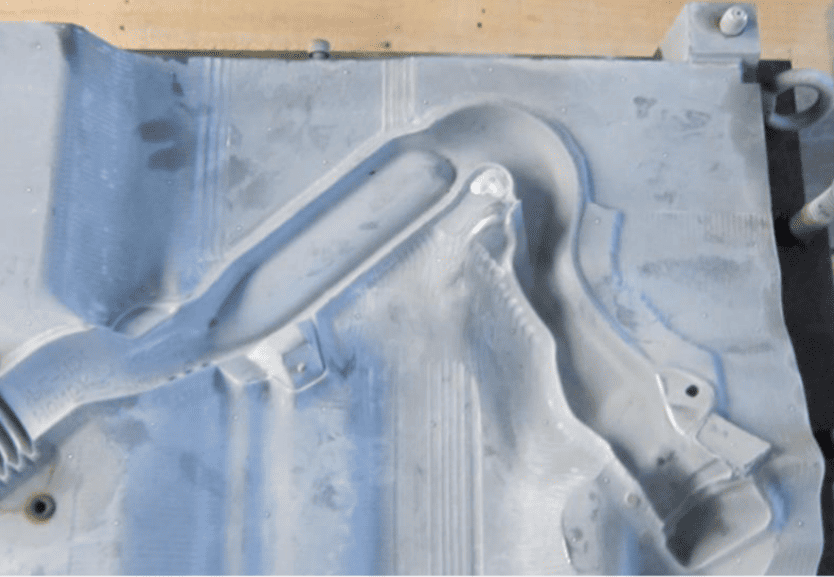
This is an example of reverse engineering a blow molding die for an automotive parts manufacturer. We received a request to create an updated die that could mold a product of the same shape as an old die made decades ago for which there were no drawings. We 3D scanned the actual die and created a 3D model of the product shape, then reflected the customer's changes in specifications. Finally, we machined the updated die from aluminum. This allowed us to organize the drawing data, making it easier to maintain the die and consider tuning, and we received positive feedback.
If you have any questions or concerns, please contact the "Equipment and Automatic Machine Parts Reverse Engineering Center."
Reverse engineering allows us to modify blow molds and remanufacture parts even if we do not have drawings.
We can provide a comprehensive range of services, from 3D scanning and CMM measurement to CAD data creation. We will support you in extending the life of your blow molds and modifying them, from on-site consultations to proposals. If you are concerned about wear or modification of your blow molds, please feel free to contact us.

What are the essential points to check when reverse engineering!? <Part 4 - Manufacturer>
Introduction Reverse engineering, while a broad term, deals with a wide variety of machines and parts. Analyzing such diverse objects using reverse engineering is no easy task. In fact, when proceeding with reverse engineering…

Enhanced safety features through reverse engineering: Area sensors
Introduction Reverse engineering often involves requests to recreate parts from older machinery that are no longer supported. However, many older machines prioritize production capacity and do not meet modern safety standards, and the machines are problematic…
Enhanced safety features through reverse engineering – Double switch
Introduction Reverse engineering often involves requests to recreate parts from older machinery that are no longer supported. However, many older machines prioritize production capacity and do not meet modern safety standards, and the machines are problematic…

Reverse Engineering for Enhanced Safety – Safety Fences
Introduction Reverse engineering often involves requests to recreate parts from older machinery that are no longer supported. However, many older machines prioritize production capacity and do not meet modern safety standards, and the machines are problematic…

Reverse Engineering and Components ~Screw Shafts~
Introduction When older machinery is beyond repair, we receive inquiries about reverse engineering. While we receive inquiries about a wide variety of machines, there are certain parts that we are surprisingly often asked to work on. This column will discuss such parts…

Reverse Engineering: How to Avoid Failure? Part 2
Introduction: Reverse engineering is a technique that can repair parts of machines whose support has ended, but it cannot repair all products and parts, and there is a possibility of failure. This column will explain how to perform reverse engineering…

Difficult even with the physical object? Reverse Engineering of Gears
Introduction Gears are a common subject of reverse engineering requests due to their failure. While the basic mechanism of power transmission is the same, the shapes and combinations of gears vary greatly depending on their application. Even I, the author, discover something new every time I research gears…

Points to note when choosing grease
Introduction: Most machines with rotating parts, such as shafts, use bearings. Inside the bearings, grease is sealed to prevent wear and ensure smooth operation. Different types of grease are used depending on the application…

Reverse Engineering Techniques: Material Selection Based on Application (Part 3)
Introduction When using reverse engineering to repair old machines and restore parts, the material of the part can be a headache. If you make a new part using the same material as the damaged part, you can't easily distinguish it by measuring it with measuring tools or by looking at its color because the original part is still available...

What are the advantages of 3D printers that shine through reverse engineering?
Introduction 3D printers have become commonplace, not only in the manufacturing industry but also among many people who use them personally as a hobby. However, there are many advantages to effectively utilizing 3D printers in the field of reverse engineering. This time…
What are the essential points to check when reverse engineering!? <Part 3 - Components>
Introduction Reverse engineering, while a broad term, deals with a wide variety of machines and parts. Analyzing such diverse objects using reverse engineering is no easy task. In fact, when proceeding with reverse engineering…

Reverse Engineering Techniques: Material Selection Based on Application (Part 2)
Introduction When using reverse engineering to repair old machines and restore parts, the material of the part can be a headache. If you make a new part using the same material as the damaged part, you can't easily distinguish it by measuring it with measuring tools or by looking at its color because the original part is still available...
Reverse Engineering Techniques - Selecting Materials by Use, Part 1
Introduction When using reverse engineering to repair old machines and restore parts, the material of the part can be a headache. If you make a new part using the same material as the damaged part, you can't easily distinguish it by measuring it with measuring tools or by looking at its color because the original part is still available...
Reverse Engineering Techniques - Material and Substance Investigation Part 2
Introduction When using reverse engineering to repair old machines and restore parts, the material of the part can be a headache. If you make a new part using the same material as the damaged part, you can't easily distinguish it by measuring it with measuring tools or by looking at its color because the original part is still available...

Reverse engineering technology - material and substance investigation
Introduction When using reverse engineering to repair old machines and restore parts, the material of the part can be a headache. If you make a new part using the same material as the damaged part, you can't easily distinguish it by measuring it with measuring tools or by looking at its color because the original part is still available...